The next enterprise AI problem isn’t intelligence. It’s context.
Companies keep buying smarter models and still get similar answers: generic strategy, plausible recommendations, and advice that could have been written for any competitor in the same industry. Adding another AI tool does not fix that. Access to documents is not the same thing as understanding the operational state of a company.
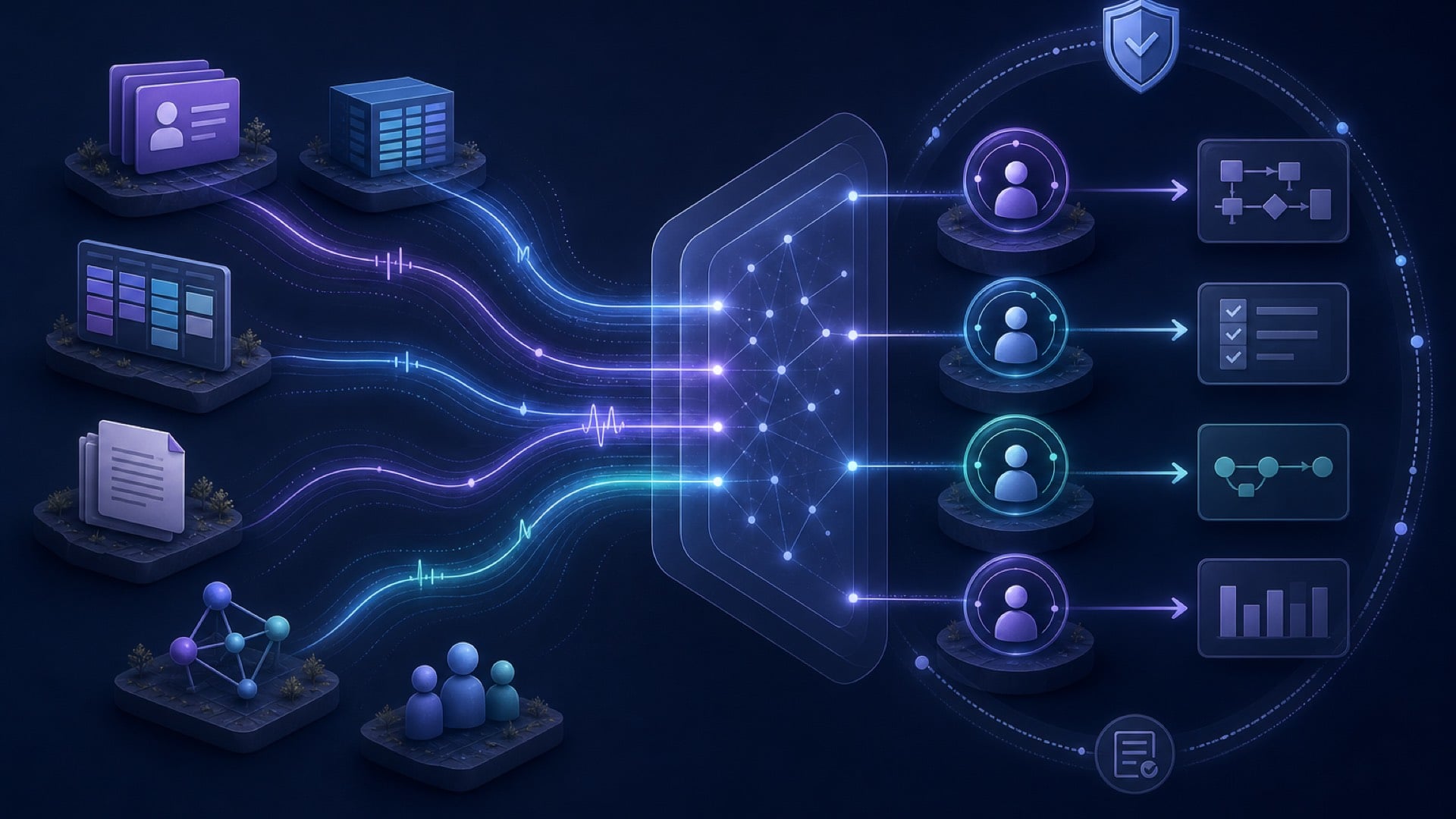
Why AI keeps giving companies similar advice
Frontier models start from largely shared public knowledge. They know how industries usually work. They know common frameworks, average playbooks, and patterns that show up across the open web.
What they do not know — unless you deliberately give them the means to know it — is your company:
- which customers are actually at risk this week
- which process is stalled in which system
- who owns the exception
- what was decided last quarter, and why
- what changed in the last hour
So the output converges. Two enterprises ask similar questions of similar models and receive similar intelligence. The model is not broken. The context is missing.
Your competitive advantage isn’t in the model
Almost every serious organization can now reach the same frontier models. Model capability is becoming table stakes.
Your durable advantage is elsewhere: proprietary business context. Customer history. Operating rules. Integration topology. Permission boundaries. Decision memory. Live state.
That is what competitors do not have. And that is what most AI tooling still treats as an afterthought — a RAG corpus here, an MCP connector there, a chatbot bolted onto a single application.
Enterprise context is more than documents
Enterprise context is not a document store with a search box.
It is the distributed reality of the company:
- customers, deals, contracts and cases in CRM
- orders, inventory, finance and compliance in ERP
- projects, tasks, workflows and handoffs
- applications, APIs and integrations
- people, roles, teams and permissions
- policies, historical decisions and relationships between all of them
RAG can retrieve pieces of that information. MCP can give an agent a way to call tools. Both matter. Neither is sufficient on its own.
Access is not understanding. Understanding the operational state of a company means knowing how those pieces relate right now — who is waiting on whom, which KPI is off plan, which workflow is blocked, and which system holds the authoritative value.
Context without signals is still passive
Even a rich context model goes stale without signals.
AI also needs to know what just happened:
- a customer changed buying behavior
- a KPI crossed a threshold
- an order was delayed
- a regulation changed
- a machine reported an anomaly
- an approval sat too long
Signals turn static knowledge into operational awareness. Without them, an agent may be well-informed about last week’s truth and blind to today’s exception. That is how “smart” assistants keep producing advice that feels sophisticated and still misses the moment that matters.
Knowing isn’t enough — AI needs somewhere to act
Insight without an execution path becomes another dashboard.
For AI to create operating leverage, it needs somewhere to act inside the same environment where work already happens: apps, APIs, workflows, and agents that can update records, open tasks, notify owners, draft decisions, or escalate under defined rules.
This is where having applications, integrations, processes and agents in one operational environment becomes decisive. The agent does not merely summarize the company. It participates in the company’s work — with boundaries.
Then comes governance
Autonomy without governance is not enterprise-ready. It is risk with a chat interface.
Identity, permissions, audit trails and human oversight determine what autonomous agents may actually do. Who is the agent acting as? What data can it see? Which systems can it change? Who reviews the action? What remains in the record afterward?
Governance and identity for agents are not compliance theater. They are the difference between an experiment and an operating model. The same is true for running agents under organizational control rather than under someone’s personal API key.
The enterprise AI architecture is changing
The old pattern was simple: employees use AI tools.
The next pattern is different: humans, applications and agents work against shared business context.
In that architecture, AI is not a side chat. It is an operational layer — one that sees context, receives signals, can act through governed interfaces, and remains accountable.
The formula is straightforward:
Business context + real-time signals + agents + ability to act + governance = the foundation for an autonomous organization.
Not another chatbot. An operating substrate.
What this means for Copyl
This is what we have been building Copyl toward since 2011.
We started by bringing business applications, integrations and processes together — because enterprises do not run on documents alone. They run on connected work.
AI has made the architectural value of that approach much larger. When models are widely available, the scarce resource is no longer raw intelligence. It is trustworthy operational context, live signals, and a governed place for agents to act.
If you are evaluating how to move from AI tools to an autonomous operating layer, start with context, signals and control — not with another model demo.
Talk to us about enterprise AI architecture →
Copyl is a Swedish platform for governed enterprise work — applications, integrations, processes and AI agents on shared business context.